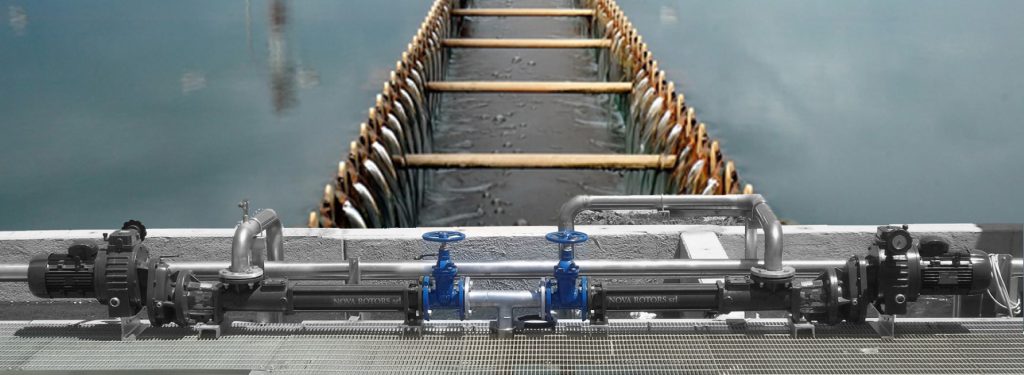
PROGRESSIVE CAVITY PUMPS, CHARACTERISTICS
– Nova Rotors specialises in the construction of progressive cavity pumps. This type of pump is highly flexible in terms of operation and application, a factor which has enabled it to achieve considerable market success. Its unique features makes it suitable for use in a variety of different industries.
The main features of this type of pump are:
Uniform flow proportional to the speed.
- Self-priming with a maximum suction lift capacity up to 8 mWC (low NPSHa application), depending on the size, the number of stages and pump speed.
- Capacity to pump heterogeneous products, containing gases, solid, abrasive and fibrous materials in the liquid matrix.
- Pumping of liquids with low or high viscosity.
- Liquid dosing capability.
- Low pulsation pumping with minimum tensile strain of the product being processed.
- High pumping pressure (6 bar per stage). Pumps are available with one to eight stages, depending on the required pressure.
Technical Video: How Does a Progressive Cavity Pump Work?
How Does a Progressive Cavity Pump Work? Discover Rotor, Stator and Applications | NOVA ROTORS
The progressive cavity pump is a volumetric, self-priming, rotary positive displacement device. The “conveying” parts consists of two elements, the rotor and the stator.
The rotor, typically metallic, is single or multiple screw with a rounded thread, extremely large pitch, considerable length and high eccentricity in relation to the core diameter.
The stator, typically elastomeric, is embedded with a cavity in the shape of a 2 or multiple screws, double threaded, compared to the rotor, and with the same eccentricity.
The rotor, rotating within the stator, is forced to perform a hypocycloid roto-translational movement. This coupling of the two elements always creates a line of contact along the profile that guarantees the seal between them. This movement creates an airtight chamber that shifts with a helical movement, from the suction casing to the delivery casing.
The Diamond series features a patented universal pin joint that ensures top performance and unprecedented flexibility of use. The standardization throughout the entire range of products achieved with this joint has resulted in optimal spare parts management as well as simplified and economical maintenance, without sacrificing reliability and long life.
Screw pump due to the small dimensions of the high, allow the pumping of the product without pulsation and keep the fluid unaltered without damage it. Accept the presence of
solid parts and can be suitable to pump fluid with viscosity up to 1.000.000 cps.
POSITIVE DISPLACEMENT PUMP > PROGRESSING CAVITY PUMPS IN DETAIL

PROGRESSING CAVITY PUMP COMPONENTS:
HOW IT’S MADE

ROTOR
It is a screw shape with circular section and, rotating in to the stator, allows the pumping of the fluid. The pressure of the pump depends on the number of stages. Every stage gives a pressure of 6 bar. Nova Rotors has two types of rotors: standard and long step type that, considering the same diameter and eccentricity, doubles the capacity increasing the pump performance.

STATOR
It is the fixed part of vulcanized rubber, contained or less on the metal tube, shaped like a circular screw quarry where the rotor rotates.
Short step type / Passo corto

Long step type / Passo lungo

uniform rubber wall thicknesses/ Statore a gomma di spessore uniforme


TRASMISSION AND JOINT
Support the axial force and the transmitted torque between rotor connection and drive.

BODY PUMP
It is the structure where the liquid is pumped from. Available with a lot of connection types .

MOTORISATION
These are the devices that give the movement to the pump: motor, hand variator, gear reducer, inverter.

COUPLING
These are the devices that give the movement to the pump: motor, hand variator, gear reducer, inverter.
Close Coupled

Type J Bearing Housing

type F Modular Bearing Unit


SEAL:
Is the connection between the fix part and the rotating part of the pump to prevent the exit of the medium. The selection of the type is depending from the fluid to pump.

Advantages of Progressive Cavity Pumps
- Constant flow proportional to speed
- Ability to handle viscous fluids
- Low pulsation
- Self-priming capability
- Suitable for fluids containing solids
You May Also Be Interested In:
- Progressive Cavity Pumps (Product page)
- Wastewater applications
- Biogas applications
- Food industry pumps
- Twin Screw pumps how it’s made
Frequently Asked Questions FAQ
What is a progressive cavity pump?
A progressive cavity pump is a positive displacement pump designed to transfer fluids through the interaction between a rotating rotor and a fixed stator. This operating principle creates sealed cavities that move the fluid continuously from the suction side to the discharge side, ensuring a constant and low-pulsation flow.
How does a progressive cavity pump work?
A progressive cavity pump works by using a helical rotor rotating inside an elastomeric stator. The rotor movement creates a series of cavities that progressively move the fluid through the pump. This design allows the transfer of viscous, dense and difficult fluids while maintaining a stable flow rate.
What fluids can progressive cavity pumps handle?
Progressive cavity pumps can handle a wide range of fluids, including high-viscosity liquids, fluids containing suspended solids, sludge, pastes and shear-sensitive products. They are widely used in industrial, environmental, food and chemical applications.
Are progressive cavity pumps self-priming?
Yes, progressive cavity pumps are self-priming and can generate strong suction capability. This makes them suitable for applications where the pump needs to draw fluid from a lower level or where the suction conditions are challenging. Performance depends on the fluid characteristics and installation conditions.
What are the main advantages of progressive cavity pumps?
The main advantages of progressive cavity pumps are constant flow, low pulsation, the ability to handle viscous fluids and solids, high dosing accuracy and reliable operation in demanding industrial applications.
AQ – HTS Raptor Twin Screw Pump Comparisons
What is the difference between a Twin Screw Pump and a Lobe Pump?
Both Twin Screw Pumps and Lobe Pumps are positive displacement pumps, but they have different operating characteristics. A Twin Screw Pump provides a continuous, low-pulsation flow and is capable of handling a wider range of viscosities, including fluids with high viscosity and solid particles. Thanks to its synchronized rotors, the HTS Raptor Twin Screw Pump ensures gentle product handling, high efficiency and excellent suction performance. Lobe Pumps are commonly used in hygienic applications but generally offer lower pressure capabilities and may produce higher flow pulsations compared to Twin Screw technology.
Why choose a Twin Screw Pump instead of a Lobe Pump?
A Twin Screw Pump is often preferred when the process requires higher flexibility, reduced product shear and the ability to handle a wide range of operating conditions. The HTS Raptor Twin Screw Pump offers continuous flow, reversible operation, high efficiency and compatibility with CIP and SIP cleaning systems. It is an ideal solution for food, beverage, pharmaceutical, cosmetic and industrial applications where reliability and hygienic design are essential.
What is the difference between a Twin Screw Pump and a Centrifugal Pump?
A Twin Screw Pump and a Centrifugal Pump operate according to different principles. Centrifugal Pumps use centrifugal force and are mainly suitable for low-viscosity fluids with constant flow requirements. Twin Screw Pumps are positive displacement pumps designed to maintain performance even when handling high-viscosity, shear-sensitive or particle-containing fluids. The HTS Raptor Twin Screw Pump provides accurate flow control, high suction capability and reliable operation across a wide range of process conditions.
Why choose a Twin Screw Pump instead of a Centrifugal Pump?
A Twin Screw Pump is the preferred choice when pumping viscous, delicate or challenging fluids where a centrifugal pump may lose efficiency. The HTS Raptor maintains stable performance with high-viscosity products, provides gentle product transfer with minimal shear and can operate efficiently at different speeds according to process requirements. It is particularly suitable for applications requiring high reliability, hygienic design and consistent performance.
Can a Twin Screw Pump handle products with solid particles?
Yes. The HTS Raptor Twin Screw Pump can handle fluids containing suspended solids while maintaining gentle product transfer. The low-shear pumping action makes it suitable for applications where product integrity is important, including food, beverage and industrial processes.
Are Twin Screw Pumps suitable for hygienic applications?
Yes. Twin Screw Pumps are widely used in hygienic industries thanks to their cleanable design and compatibility with CIP (Cleaning-In-Place) and SIP (Sterilization-In-Place) processes. The HTS Raptor is designed to meet the demanding requirements of food, dairy, pharmaceutical and cosmetic applications.